Our trained and empathetic volunteers are available to listen to and support you.
1 (855) 909-9038 , ext. 12000
Coming Together to Exist
In 2003, Fondation Émergence launches the National Day Against Homophobia in Quebec (now an international observance known as the International Day Against Homophobia, Transphobia and Biphobia), contributing to greater recognition of trans realities in the fight against discrimination.
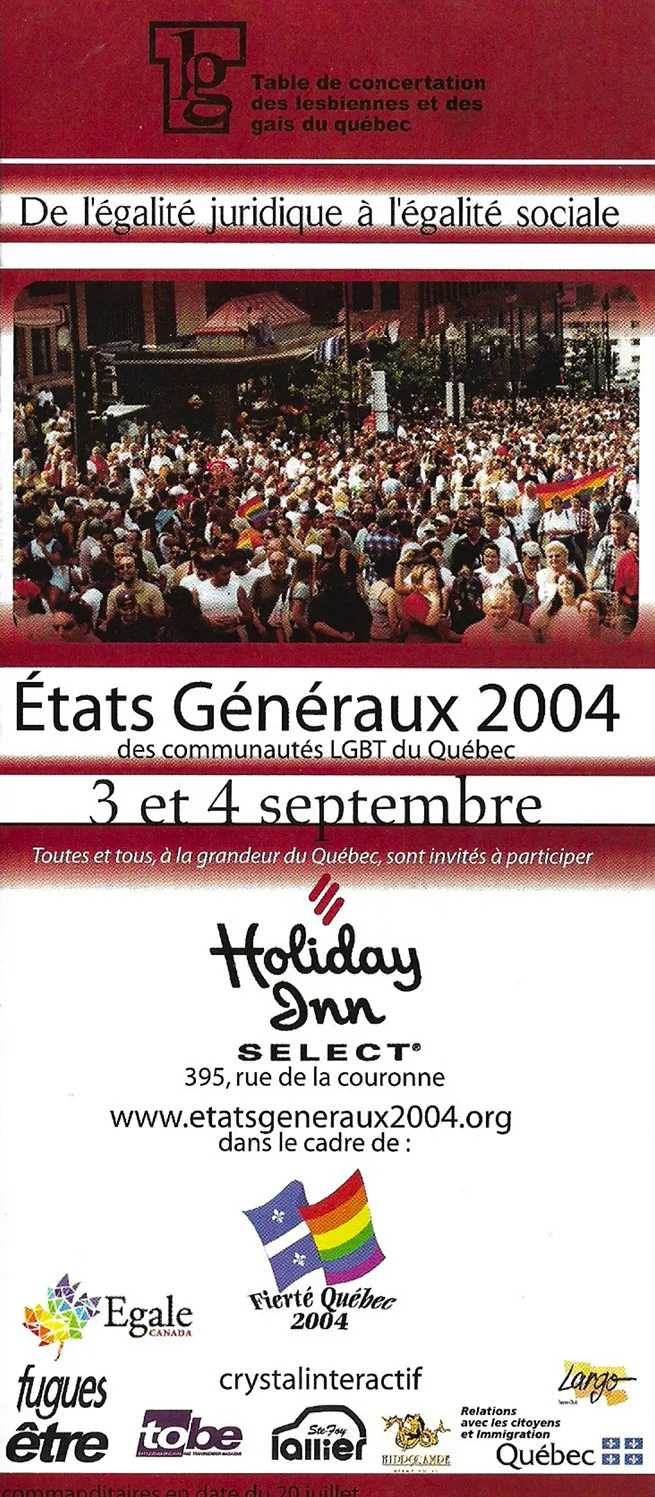
In 2004, the États généraux (“From Legal Equality to Social Equality”), organized in Quebec City by the Table de concertation des lesbiennes et des gais du Québec (TCLGQ), now the Conseil québécois LGBT, mark a key moment of collective reflection, following the legal advances of the 1990s and early 2000s.
ATQ participates actively as the only officially recognized trans community organization at the time. Its presence helps bring trans realities into discussions that had largely focused on gay and lesbian issues, including relationship recognition, civil unions, and the fight against homophobia.
These contributions help ensure that the final report explicitly includes trans issues—particularly in relation to health, rights, and recognition—which had long remained on the margins.
As Claude Côté noted: “Gay men and lesbians will welcome bisexual and transgender people into their ranks—a first.”
2005
Founding of the CTTQ
Following these États généraux, the idea emerges to create a coalition bringing together organizations working with trans people. Julie-Maude Beauchesne becomes its founding president. After several meetings among community stakeholders, the Coalition des transsexuel(le)s et transsexué(e)s du Québec is officially established on February 3, 2005. In 2007, it adopts the name Coalition des transsexuelles et transsexuels du Québec, before ceasing its activities shortly thereafter.
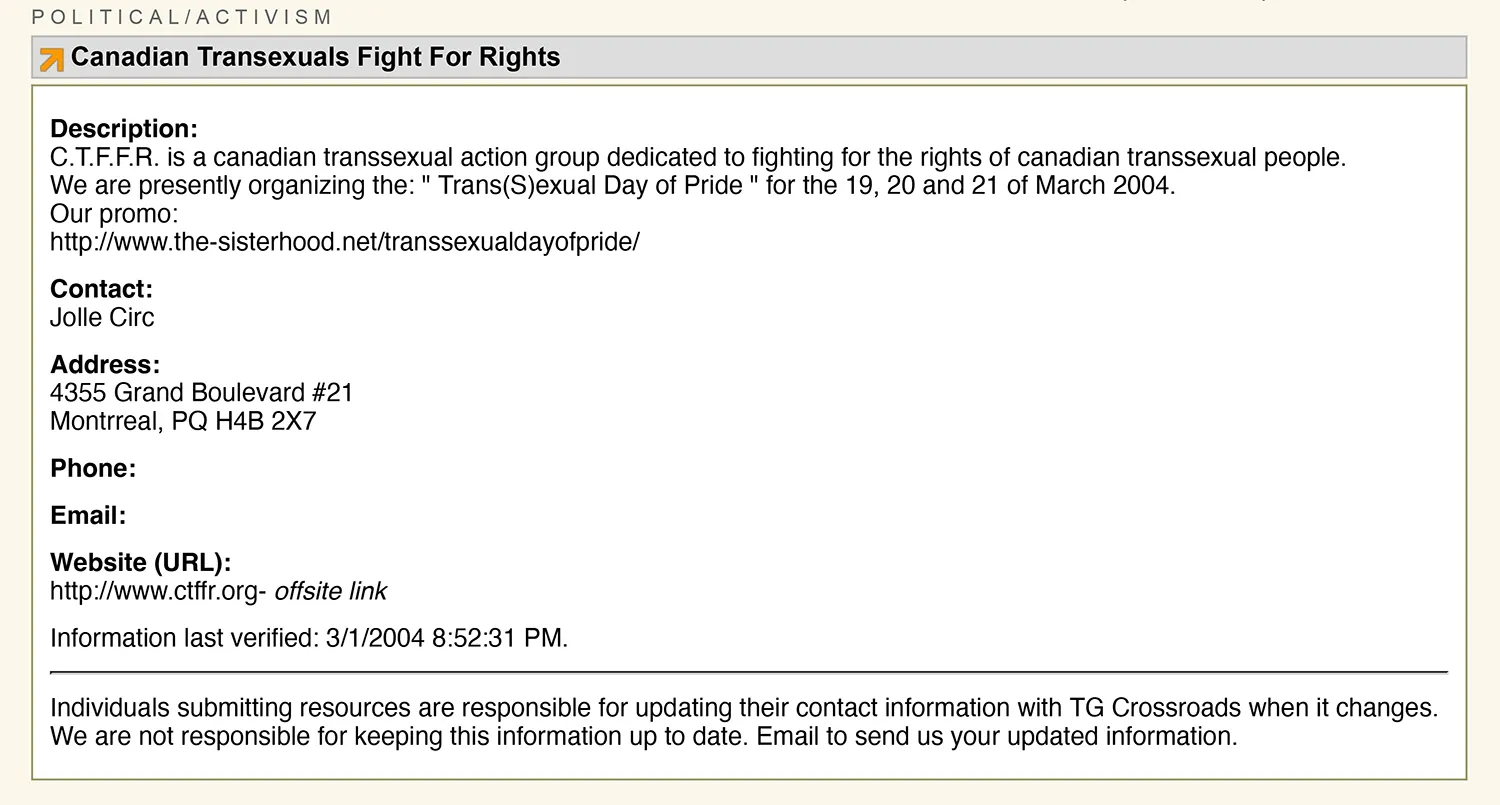
From its founding, the CTTQ resumed organizing Quebec’s Transsexual Pride Day after a six-year interruption. Danielle Chénier, representing first the CTTQ and later ATQ, became its main organizer from 2005 to 2017, ensuring the continuity and development of the event.
The history of this event remains complex to trace, having undergone several name and format changes, as well as transitions between different organizations, particularly in a context of tensions within the communities at the time. That said, since 2005, ATQ has been the organization behind what has become the Festival Fierté Trans.
In 2005, ATQ sets new objectives: strengthening ties with the medical community to better meet the needs of its clientele, expanding its awareness-raising activities in schools, and contributing to the dissemination of scientific and medical knowledge. The organization also begins developing an archival collection on the history of transsexuality—a term still in use at the time—with the goal of making it accessible online.
The possibility of a name change and the recognition of the term “trans” as an official designation are also raised.
At the same time, ATQ adopts its first codes of ethics and professional conduct, as well as a formal volunteer agreement, marking a further step in the organization’s structuring.
In 2006, ATQ becomes a member of the Conseil québécois des gais et lesbiennes (CQGL), now the Conseil québécois LGBT.
The organization also adopts its first bylaws and takes on a more formal role in organizing Quebec’s Transsexual Pride Day. Membership is now open to any individual, organization, or student association that shares ATQ’s values and meets its criteria.

In 2007, ATQ adopts a new logo inspired by the colors of the trans pride flag—pink, purple, and blue—rooted in activist movements.
The organization also establishes new governance tools, including a statement of principles and letters patent.
A collaboration with Dr. Pierre Brassard helps improve support for individuals seeking access to gender-affirming surgery. ATQ also launches a newsletter and, for the first time, marks Trans Day of Remembrance, created in 1998 in memory of Rita Hester and trans people who have been victims of violence.
2008
New Offices
ATQ’s offices relocate to the Centre communautaire gai et lesbien de Montréal (now the Centre communautaire LGBTQ+ de Montréal), located at 2075 Plessis Street.

In early 2008, ATQ launches a survey among its members to better understand their needs and adapt its services. The survey addresses issues related to identity, transition, community and family life, as well as discrimination.
That same year, ATQ is invited to speak before the Commission des affaires sociales of the National Assembly of Quebec as part of consultations on gender identity and a bill aimed at promoting equality between women and men, amending the Quebec Charter of Human Rights and Freedoms.
In June, ATQ participates in the CPATH conference held in Toronto, which focuses in particular on access to healthcare and the availability of resources across provinces. The organization then joins this national network.
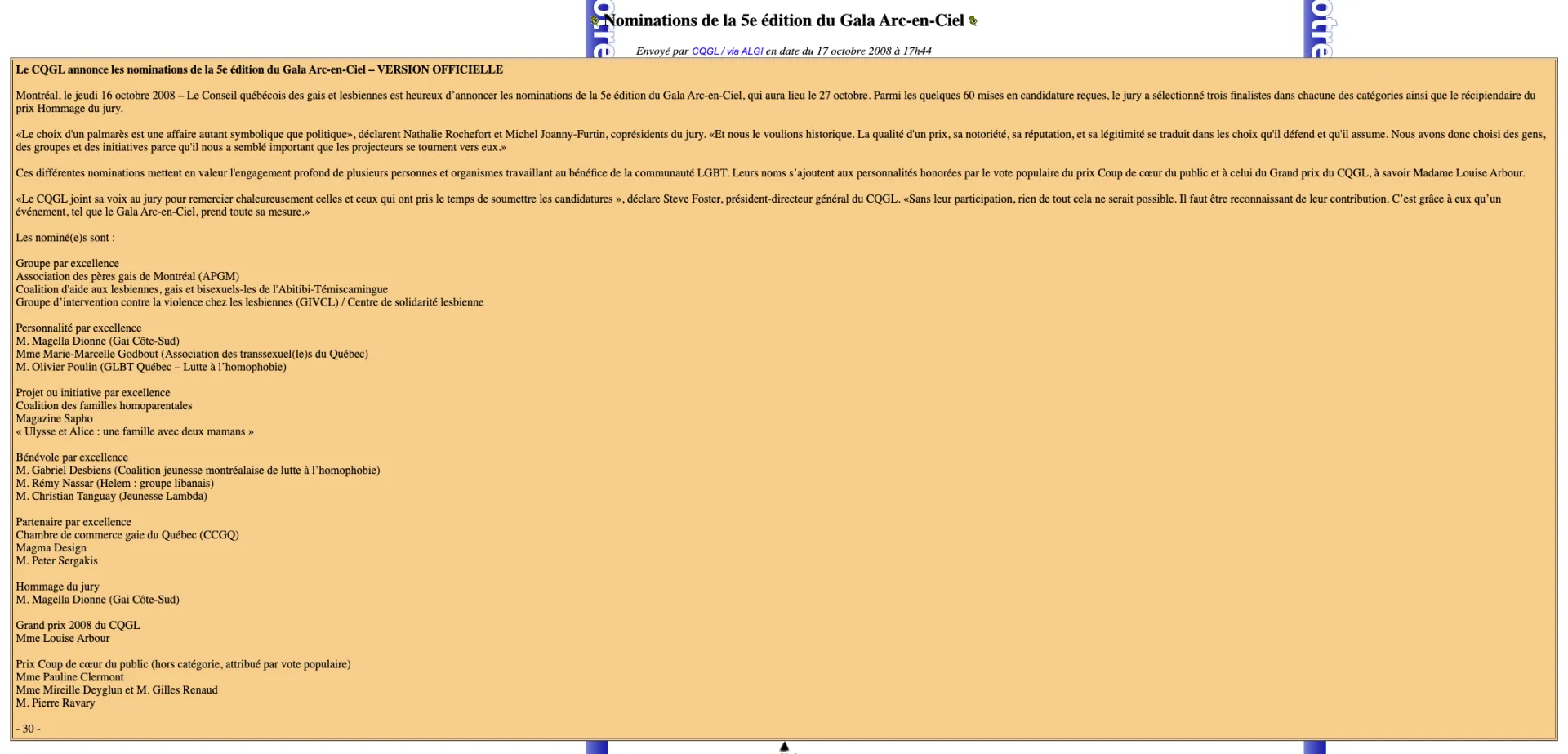
In 2008, Marie-Marcelle Godbout receives the Jury Tribute Award at the 5th edition of the Gala Arc-en-Ciel, organized by the Conseil québécois des gais et lesbiennes (CQGL), in recognition of her pioneering work.
That same year, ATQ joins social media, expanding its reach and communication channels.
Marie-Marcelle steps down from the board of directors while continuing her involvement by facilitating workshops and supporting the listening and referral line.
Call us 24/7
Our trained and empathetic volunteers are available to listen to and support you.
1 (855) 909-9038 , ext. 1