Our trained and empathetic volunteers are available to listen to and support you.
1 (855) 909-9038 , ext. 11980
1980: ATQ Takes Root
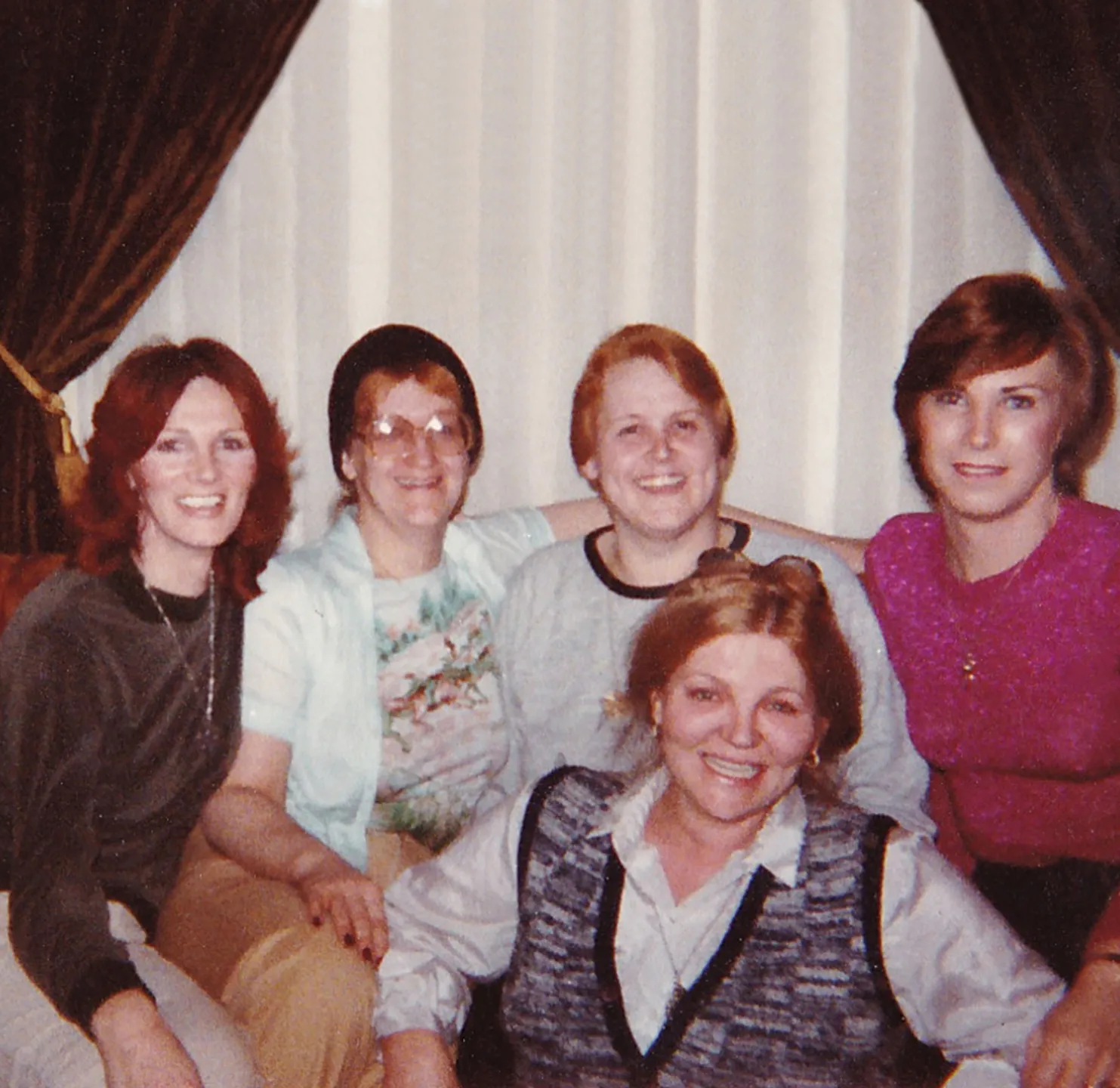
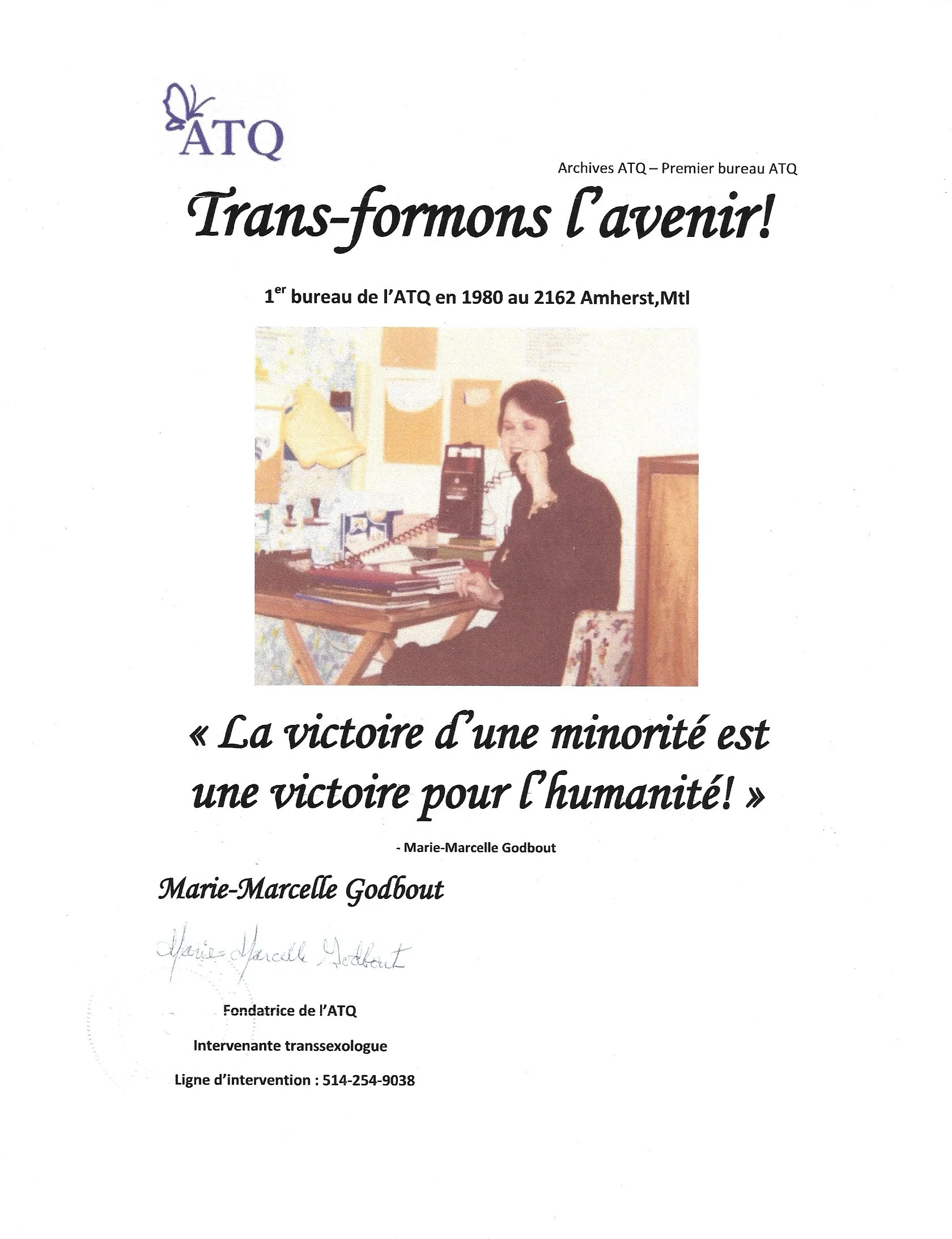
On January 7, 1980, Marie-Marcelle Godbout and four other “housewives”—Manon Frigon, Vanessa Giovannito, Marie-Claude Daigle, and Marie-Josée Marcil—founded Aide aux Transsexuels du Québec Inc., the first association dedicated to trans people in Quebec. The first office was established at 2162 Amherst Street, while the organization’s registered address was Marie-Marcelle’s personal residence on Sicard Street in Montreal. This founding marked a pivotal moment: for the first time, trans people in Quebec created an organization by and for themselves.
Note on Language Used
Transsexual?
The term “transsexual” is used throughout this timeline because it reflects the language many people used at the time to describe themselves. Today, the term “trans” is more commonly used, but ways of self-identifying have evolved over the years—and continue to evolve. At that time, many gender-nonconforming individuals also identified as “transvestite.”
The purpose of this organization reflects a vision that is both clear and ambitious, as outlined in its founding documents, which notably aimed to:
Help transsexual individuals better understand their situation and their personal, familial, and social challenges; Organize gatherings where transsexual individuals could share their frustrations, concerns, and fears; Bring together people able to support transsexual individuals during difficult times; Maintain a group that fosters self-confidence and resilience in overcoming challenges; Establish a home to welcome transsexual individuals during periods of financial or psychological hardship, offering them the opportunity to regain autonomy—or, in some cases, to live their final moments with dignity.
Within this framework, Marie-Marcelle Godbout provided assessments, follow-up, and support to individuals who were questioning or in transition. She also set up a telephone support line in her home, available day and night.
October 20, 1980
First Meeting for Transsexual Individuals
On October 20, 1980, ATQ organizes the first meeting dedicated to transsexual individuals at the Hôtel Mont-Royal. These gatherings, known as the “Ateliers de Transformation du Québec” (Quebec Transformation Workshops), quickly become essential spaces for sharing, mutual support, and solidarity. This founding moment paves the way for conferences and public speaking engagements by Marie-Marcelle, helping to break the silence surrounding a reality that remained largely taboo.
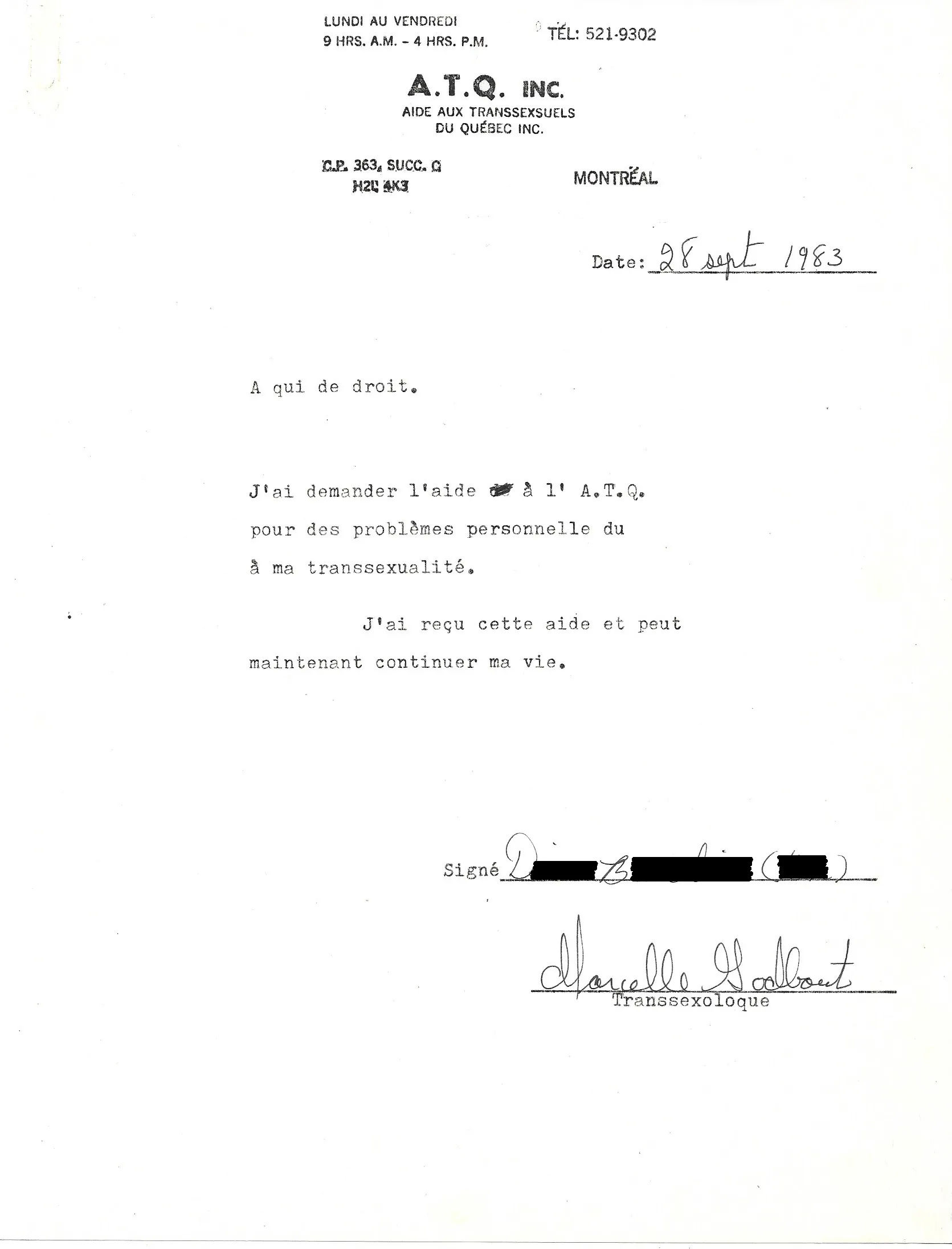
As part of its incorporation process, ATQ sought the support of several institutions, which quickly recognized the need for such services despite the social context of the time. Among the letters of support preserved in the archives are those from the Groupe de recherches cliniques en sexologie at the Université du Québec à Montréal and the Quebec Ministry of Social Affairs (now the Ministry of Health and Social Services).
To facilitate administrative processes for its users, Marie-Marcelle Godbout issued “attestations” on ATQ letterhead, bearing an official seal and her signature. These documents confirmed that the individual was in transition and living under their “new identity.” Although Marie-Marcelle in some ways forged her own specialization as a “transsexologist,” these letters—signed by a “specialist”—helped legitimize individuals’ transition journeys in the eyes of physicians, financial institutions, and other authorities, encouraging greater recognition and cooperation.
At the same time, ATQ regularly organized gatherings for its members, known as the “Ateliers de Transformation du Québec,” which provided spaces for exchange, support, and solidarity.
February 19, 1981
Death of Christine Rollins
Christine’s death in February 1981—following postoperative complications and within a context marked by intolerance—becomes a turning point for Marie-Marcelle. This personal tragedy acts as a catalyst: she chooses to fully commit to advocating for the rights of trans people, determined that no one should have to endure what Christine had experienced.
With the support of ATQ’s members, Marie-Marcelle Godbout begins, in 1982, to dedicate her efforts to raising awareness of the organization and its mission among the public and government institutions.
Drawing on her own lived experience, she quickly becomes a key resource for the community on issues related to social and medical transition.
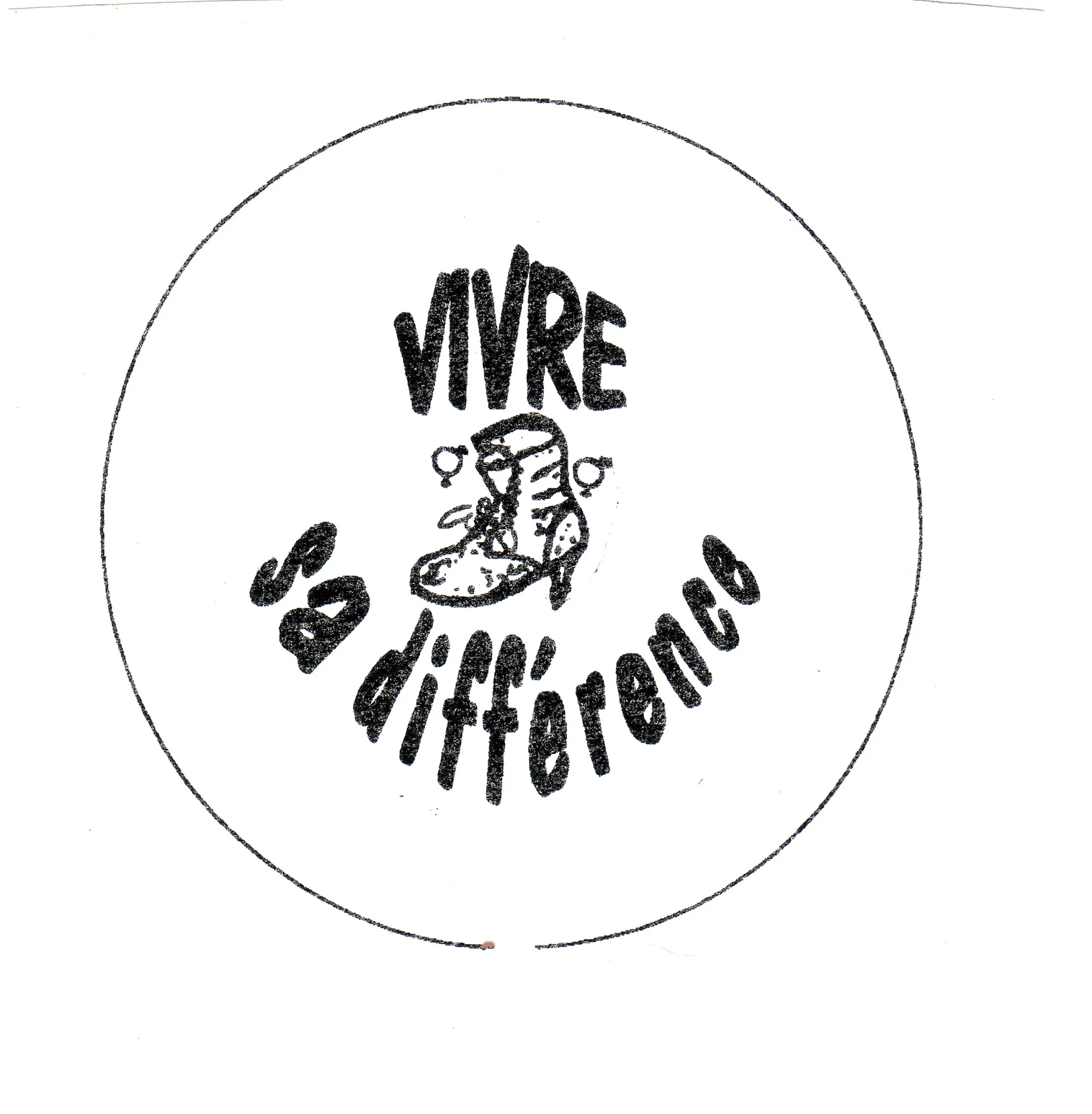
“Living one’s difference” and “Finding one’s identity” emerge as unifying slogans, while the high-heeled boot becomes an emblematic symbol of the organization.
Starting in 1983, ATQ sponsors the “Relais” project, aimed at sharing information about trans realities in order to support social and professional integration.
That same year, Marie-Marcelle Godbout begins giving talks in CEGEPs and universities, helping to raise awareness among students about issues related to trans identities.
Through ATQ, she also initiates outreach efforts with parents to better support young people facing rejection or misunderstanding within their families.
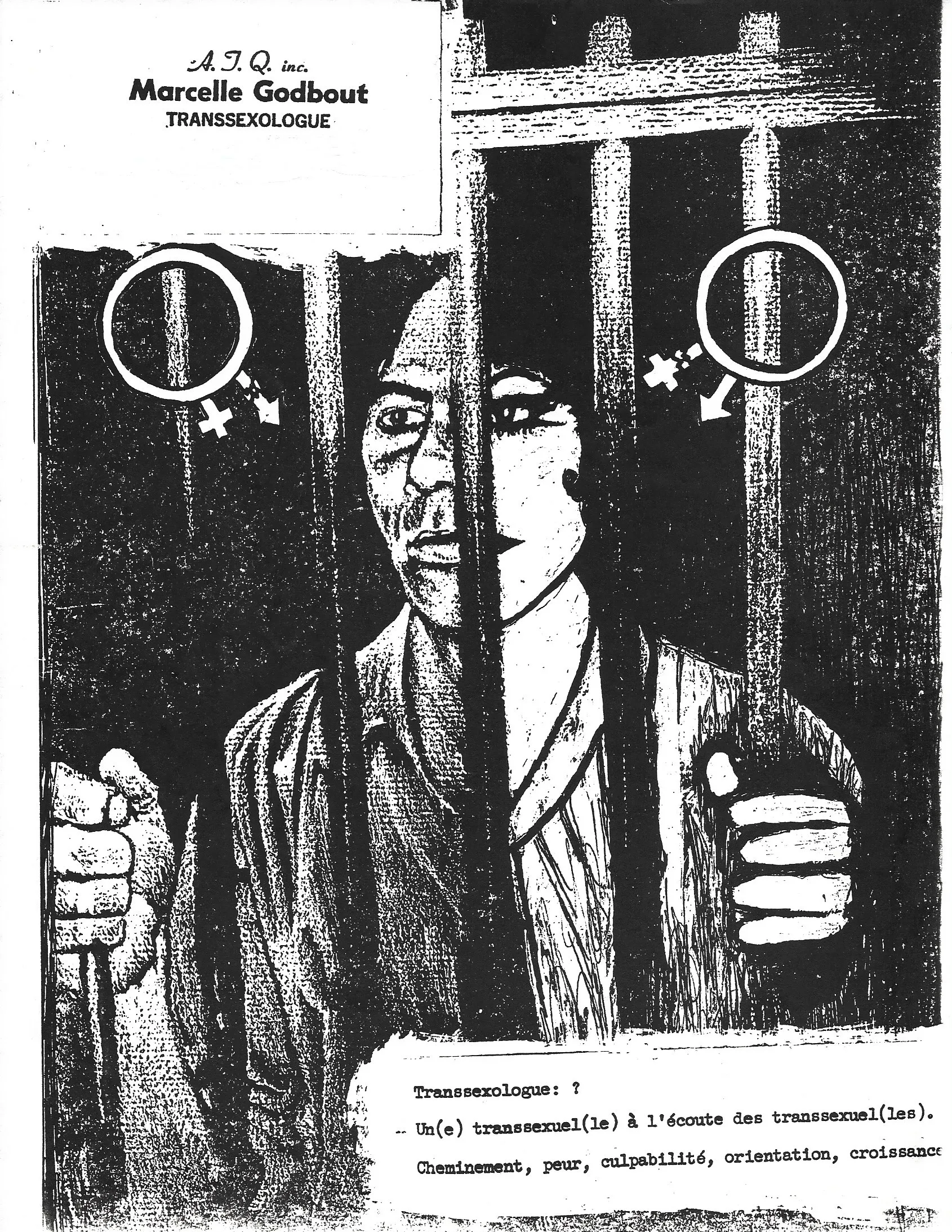
Aware that many of ATQ’s users were facing legal issues, Marie-Marcelle Godbout provided ongoing support, both during their incarceration and after their release. ATQ thus established itself as a key resource, serving not only incarcerated individuals but also correctional institutions and parole officers.
In 1984, a tragic event shook the community: Nancy Gilmore, an ATQ user, was found dead in the snow.
When interviewed by the media, Marie-Marcelle highlighted the realities faced by many trans women at the time: reliance on prostitution, substance use, or involvement in crime—often among the only means available to finance their transition and hope for a dignified life.
1985
Association des transsexuels et transsexuelles du Québec
In 1985, ATQ adopts a new name and becomes the Association des transsexuels et transsexuelles du Québec.

ATQ commits to supporting Maggie, charged with manslaughter, throughout her incarceration and after her release. During this highly publicized trial, Marie-Marcelle Godbout and Marie-Josée Marcil testify in court, highlighting the need for services adapted to trans people in correctional settings.
By appearing openly on television, notably on the program L’heure juste hosted by Jean-Luc Mongrain on TVA, Marie-Marcelle helps bring ATQ to the attention of the broader public and establishes herself as a spokesperson for the community.
In December, Marie-Marcelle Godbout and Marie-Josée Marcil welcome Christine Jorgensen, who comes to perform a recital at the cabaret Les Folies Bergères. The experience is short-lived: faced with sparse audiences, the American star leaves Montreal after only two performances.
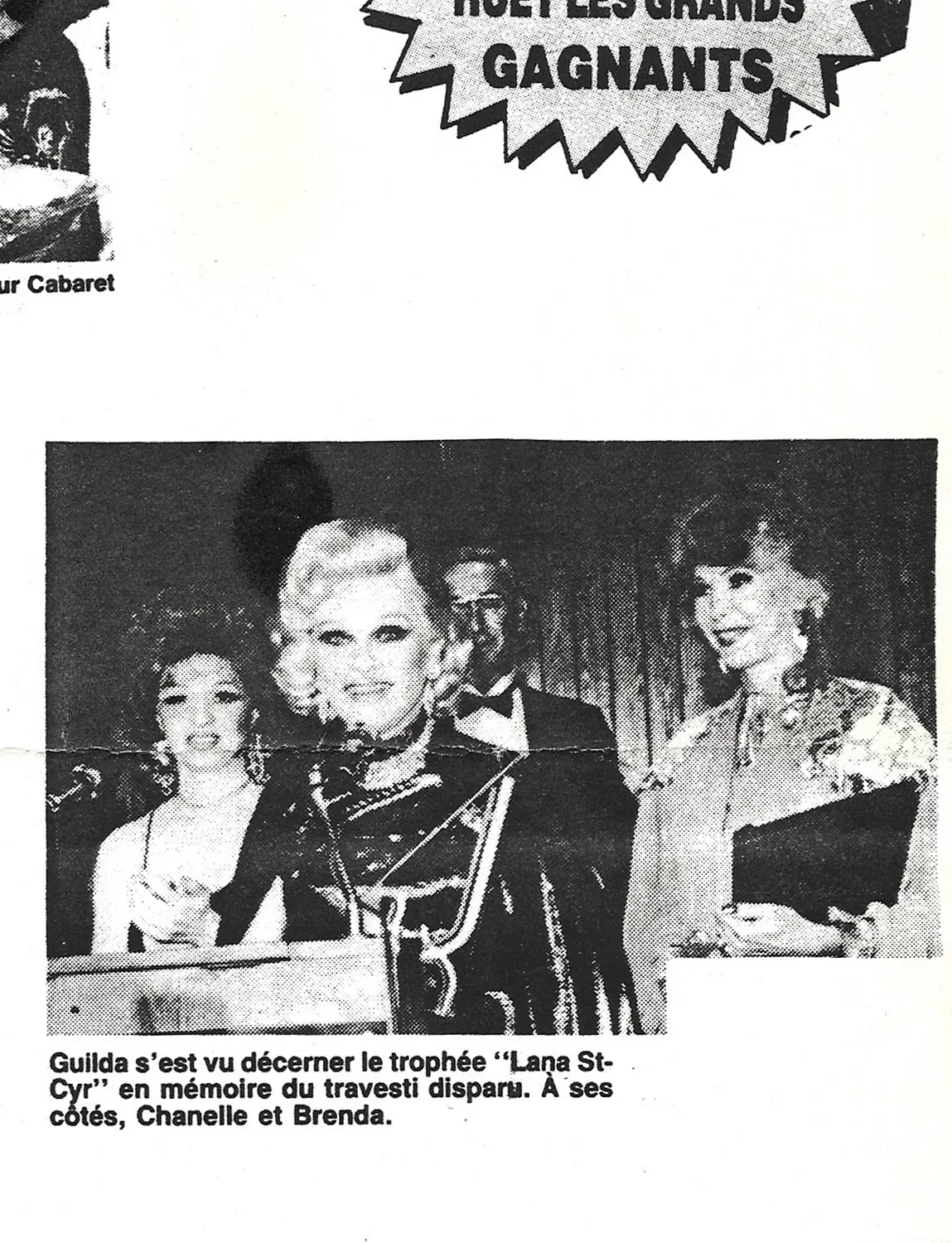
February 22, 1986 marks the death of Lana Saint-Cyr, a friend and mentor to Marie-Marcelle. In her honor, the first Gala Fierté is held on April 13 of the same year.
A few weeks later, on May 3, 1986, the International Day of Transsexualism is established, in tribute to Christine Jorgensen, the first person to gain international recognition for undergoing gender-affirming surgery. This date also becomes associated with what would later be known as the Lana Saint-Cyr Gala, including an award bearing her name. The day quickly becomes an important annual occasion to celebrate and honor the memory of pioneers.
That same year, Marie-Marcelle appears on Radio-Canada television, on the program Femmes d’aujourd’hui hosted by Aline Desjardins, continuing her work of raising awareness and increasing visibility.

From 1988 onward, traces of the organization become more scarce, both in digital and physical archives.
That same year, Marie-Marcelle Godbout appears on the program Parler pour parler, broadcast on Radio-Québec, continuing her work of raising awareness and demystifying trans realities for the general public.
In 1987, ATQ strengthens its ties with parole officers in the Greater Montreal district following a conference presented during their annual gathering.
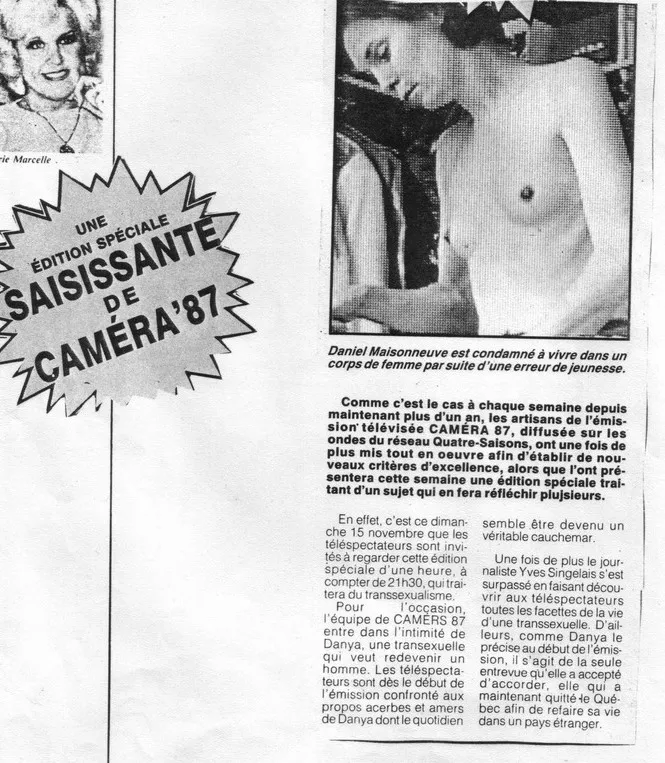
It is also during this time that Marie-Marcelle Godbout meets Danya, who is considering detransitioning. Her story, widely covered in the media, is featured in the press and addressed in the documentary program Caméra 87.
Call us 24/7
Our trained and empathetic volunteers are available to listen to and support you.
1 (855) 909-9038 , ext. 1